

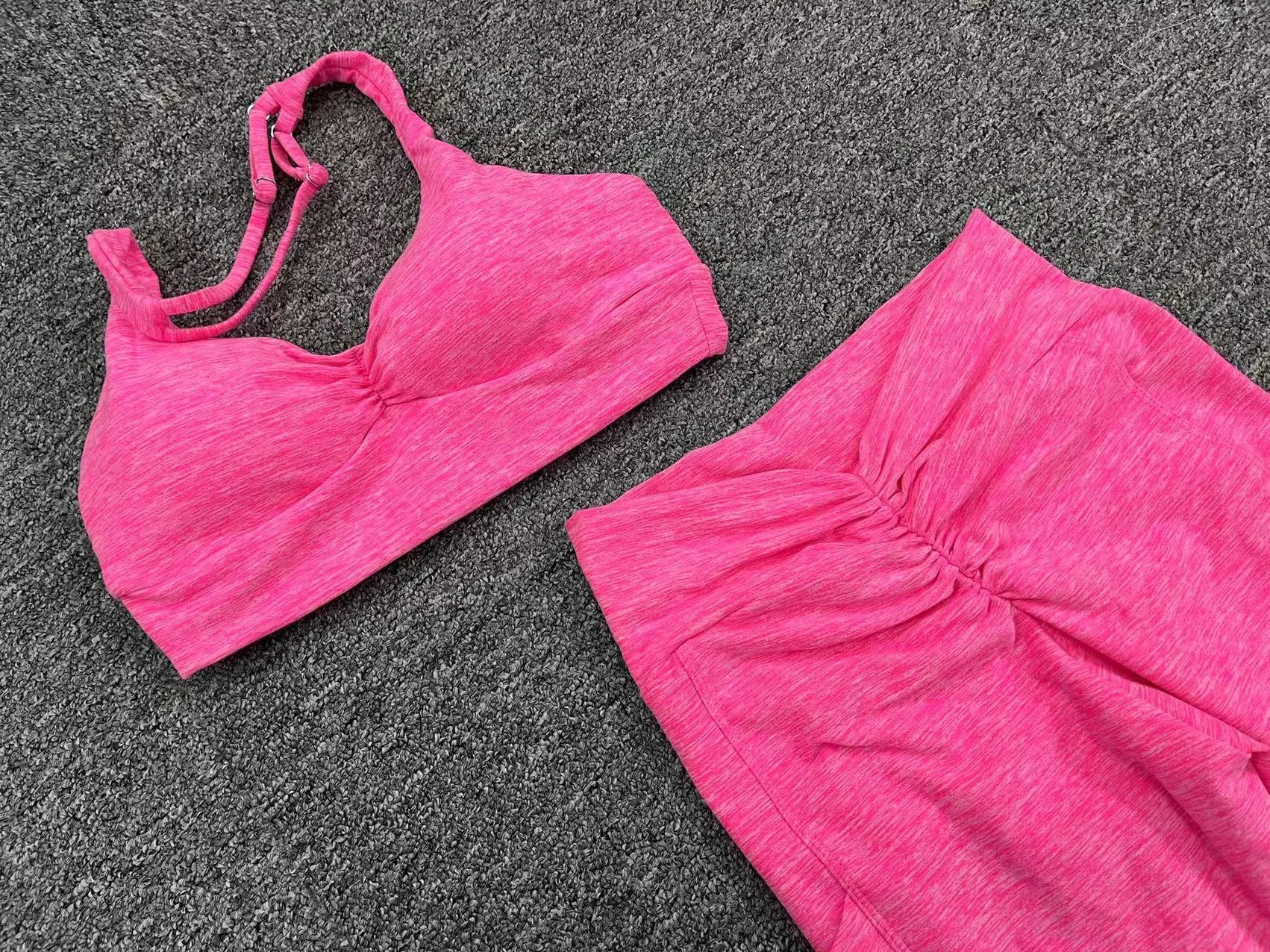
The mark of well-sewn stretch fabric: seams that lie flat, stretch with the body, and recover without puckering.
Stretch fabric is what makes activewear work — and what makes activewear harder to sew than almost any other garment category. A legging has to stretch around the body without popping a seam, recover without sagging, and lie flat without puckering. All of that comes down to how the fabric is stitched. Here’s what goes into sewing stretch fabrics well, and what to look for in a manufacturer.
Why stretch fabric sews differently
A woven shirt is sewn with a rigid seam, and that’s fine, because the fabric itself doesn’t stretch. Activewear is knit, and knit fabric moves in every direction. If you sew it with the same rigid settings you’d use on a woven, one of two things happens: the seam either snaps when the garment is pulled, or it resists the stretch and causes the fabric to pucker into a wavy, rippled edge. The stitch has to be able to stretch exactly as far as the fabric does — and recover just the same.
That single requirement shapes every other decision: the needle, the thread, the stitch type, and the machine settings.
Choosing the right needle
Needle choice is the first line of defence against ruined fabric. For stretch knits you use a ballpoint, jersey, or stretch needle — a needle with a rounded tip that slides between the fibres instead of piercing them. That matters because a sharp, universal needle cuts the knit loops as it passes through, which leaves holes that ladder into runs the first time the garment is stretched.
For high-elastane fabrics with a lot of recovery, a stretch needle goes a step further with a modified scarf and eye that reduce skipped stitches. It’s a small detail with a big visible effect: skipped stitches and pinholes almost always trace back to the wrong needle.
Thread and tension
The thread on a stretch seam has to be as elastic as the fabric, so activewear is sewn almost exclusively with polyester or textured polyester thread. Polyester has the stretch and the strength to recover with the knit, where cotton thread would snap or hold the seam stiff. Tension matters just as much: too tight and the seam puckers the fabric into permanent ripples, too loose and the thread loops on the surface and the seam loses strength. Balanced tension is a machine-by-machine, fabric-by-fabric setting — not a one-time choice.
Stitch types for stretch seams
Not all stretch seams are created equal. Most activewear combines three or four stitch types, each with a job:
- Overlock (serger) — the workhorse. It trims and wraps the raw edge in thread while it sews, so the seam can stretch without fraying or breaking. This is the stitch that holds most of a garment together.
- Flatlock — lays the seam flat against the skin instead of raising a ridge, which is why it shows up on seams that touch the body directly. It’s the stitch behind the “chafe-free” feel of good activewear.
- Coverstitch — the stretch hem. It produces the twin rows of stitching you see on leg openings, armholes, and necklines, giving the edge a professional finish that still stretches and recovers.
- Stretch straight stitch / zigzag — used selectively for topstitching and areas that need a little more give or structure.
The right combination depends on the garment: a seamless-looking pair of leggings leans on flatlock and coverstitch, while a compression top relies on overlock with reinforced stress points.
Machine settings that matter
Two settings separate a clean stretch seam from a wavy one. The first is differential feed, which controls how fast the two layers of fabric are fed relative to each other. Set correctly, it stops the fabric from stretching out or bunching as it passes under the needle — the difference between a seam that lies flat and one that ripples. The second is presser foot pressure; too much pressure drags on the knit and stretches it as it sews, so the finished seam is longer and looser than the fabric around it. Experienced operators tune both for each fabric weight and stretch percentage.
Seam construction and finishing
How a seam is built matters as much as how it’s stitched. Stretch seams need a clean, consistent seam allowance, cut in the direction the fabric stretches, so the edges don’t curl or flag. Stress points — the crotch, the underarm, the waistband — get reinforced with tape or a second pass of stitching, because that’s where a legging will fail if it’s going to. And on premium pieces, bonding is increasingly used alongside or instead of stitching, welding panels together with adhesive film for a seam that’s flatter and even more durable.
Common defects — and how to avoid them
Almost every stretch-sewing problem falls into a short list, and each has a known cause:
- Skipped stitches — almost always a needle problem: the wrong type, a dull tip, or a needle too small for the thread.
- Puckering and wavy seams — tension too tight, or differential feed and presser foot pressure set wrong for the fabric.
- Needle holes and runs — a sharp or universal needle piercing the knit, rather than a ballpoint sliding between fibres.
- Seam slippage — the thread pulling loose from the edge, usually from too small a seam allowance or a too-loosely knitted fabric.
A factory that sews stretch well doesn’t just fix these when they appear — it sets up its machines to avoid them on every run.
Testing stretch seams
A stretch seam is only as good as its recovery, so every run should be tested, not just inspected. In production we check three things: the seam stretches to the same percentage as the fabric without the thread breaking, it returns to its original length without the edge waving or curling, and it survives a wash cycle without loosening or laddering. For leggings and compression pieces, we also pull-test the stress points — the places a customer will actually strain when they squat, lunge, or sprint.
The takeaway
Sewing stretch fabric is a discipline, not just a step in the line. The right needle, a polyester thread with balanced tension, the correct stitch type for each seam, and machine settings tuned to the fabric all have to come together — and they have to be tested, because a seam that looks fine on the hanger can fail the moment it’s stretched. When you’re choosing a manufacturer, this is exactly what you’re paying for: the difference between activewear that moves with the body, and activewear that fights it.
Sew stretch fabrics that move with the body
Tell us what you’re making and we’ll recommend the right fabric and seam construction — with a quote within 24 hours.